

If you’re anything like us, you hear about AI every day. Most of it is about content, automation, or productivity. What might be easy to miss, but end up being just as important, is how AI is starting to change the way software itself is built (and who can build it).
That matters because, since the beginning of computing and software development, building something custom has usually meant (at least one of) three things: a large budget, a long timeline, or a level of complexity that makes the whole idea feel out of reach.
That’s part of what makes Google AI Studio so interesting. It isn’t just a place to experiment with prompts. Google now describes it as a way to quickly build and deploy full-stack apps with natural language, including server-side logic, secrets management, npm package support, and Firebase integration. And it delivers in a big way.
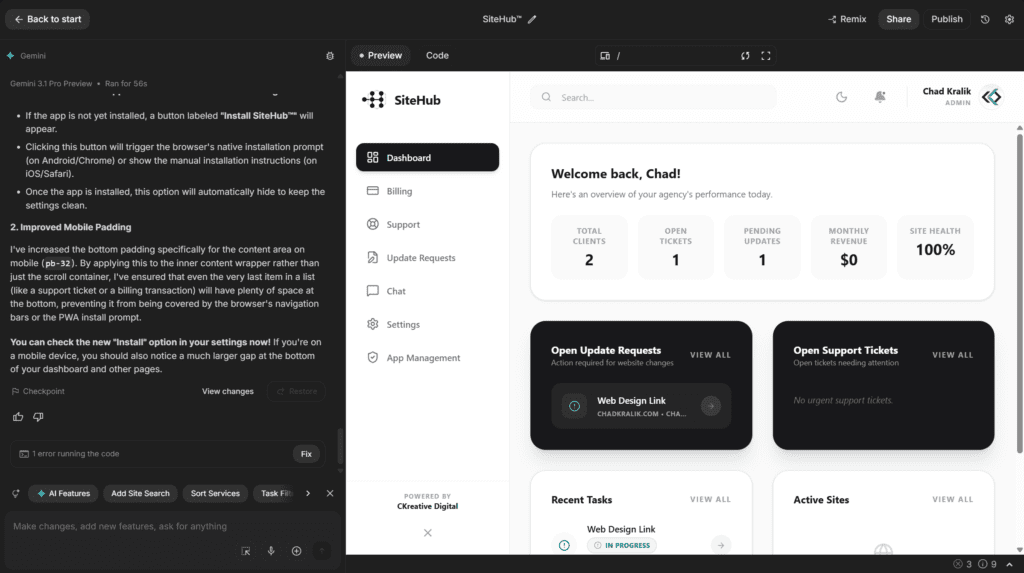
Google AI Studio Dashboard
What Google AI Studio actually does
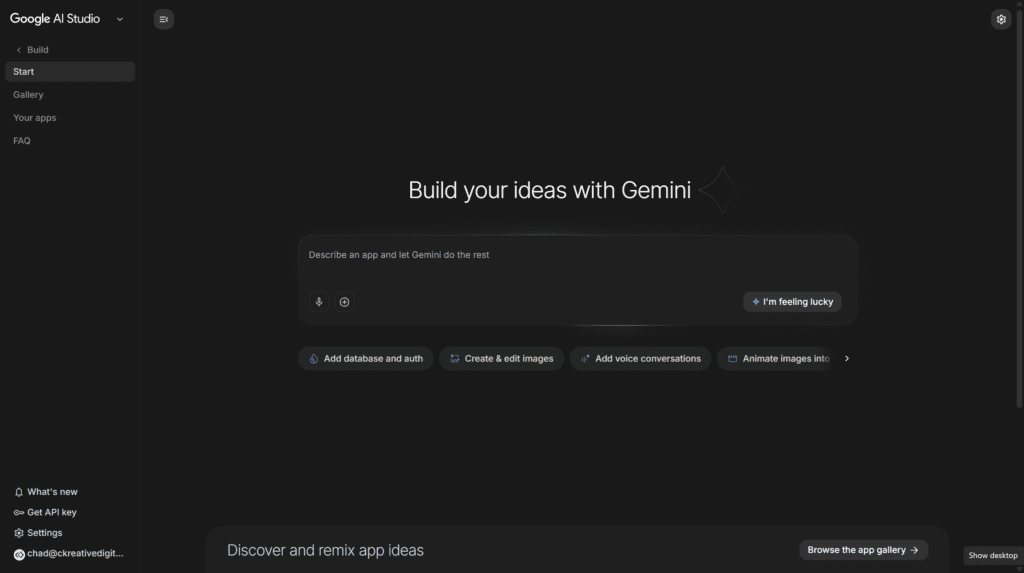
At a high level, Google AI Studio lets you describe what you want to create and then generates a working application structure using that prompt.
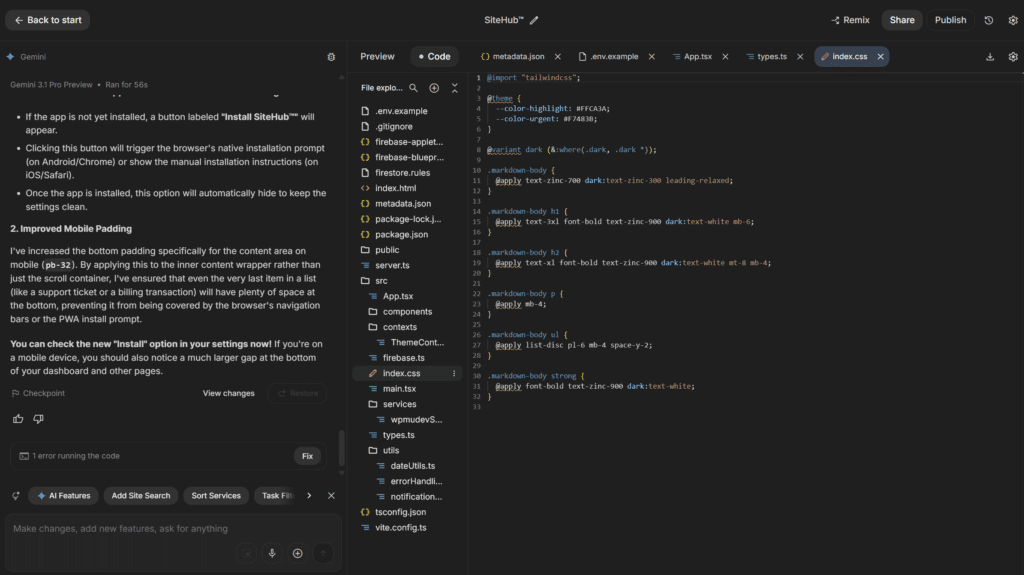
Instead of starting with a blank project and wiring everything together manually, you start with intent. From there, the platform can generate code and files, show a live preview, and give you something functional to build upon. Google says Build mode creates a complete application environment that can include a web frontend, a Node.js server-side runtime, and full-stack app iteration through chat or annotation mode.
That does not mean the work is finished for you, but it does mean the starting point looks very different from what it used to.
The capabilities that stand out
What makes tools like this worth paying attention to is not just that they can generate code. It’s that they can remove a lot of the friction that normally slows ideas down.
A few things stand out:
It gets you to a usable starting point quickly. You can move from an idea to something real enough to test in far less time than a traditional build process usually takes. Google’s Build mode is explicitly designed for quickly creating and iterating on apps from prompts, with code and a live preview generated together.
It thinks beyond just the interface. AI Studio’s full-stack features include a server-side runtime, secrets management, and the ability to automatically provision Firebase services like Firestore and Firebase Authentication when the app needs them.
It is built for iteration. Google says the system can maintain context across prompts, manage multiple files, and propagate changes across the stack, which is a big reason the experience feels more like shaping a product than restarting it every time you want something to change.
Why this matters more than it might seem
On the surface, this just sounds like a faster way to build apps.
But for small business owners, entrepreneurs, and people building a personal brand, it means something more practical than that. It means the distance between an idea and a working system is getting smaller.
For a small business owner, that could mean finally having a client portal, onboarding flow, or internal workflow that actually fits the business instead of forcing everything into generic software.
For an entrepreneur, it could mean getting a new offer, service tool, or simple customer-facing app in front of real users while the idea is still fresh.
For someone building a personal brand, it could mean creating a members area, resource hub, intake tool, or custom lead experience that feels much more intentional than stitching together links, forms, and DMs.
That is really the shift.
Not everyone suddenly needs an app. But a lot more people can realistically have one now.
So what does this actually mean for you?
Unless you plan to build a brand or a company online, it probably means nothing. But you’ve read this far, so here it is…
For most small business owners, entrepreneurs, and personal brand builders, the biggest barrier usually is not the idea itself. It’s the gap between “This would be helpful,” and “I actually have the time, budget, and technical ability to build it.”
That gap is starting to get smaller.
Even if you don’t want to tackle the project yourself, professionals will be able to provide that service at a fraction of the cost of traditional app development.
Tools like Google AI Studio make it much more realistic to take an idea that would have felt too expensive, too technical, or too time-consuming a year ago and turn it into something usable in a matter of days instead of months. Google’s current documentation describes AI Studio as supporting full-stack runtimes, server-side logic, package support, deployment options, and Firebase-backed features like authentication and persistent storage.
- For a small business owner, that could mean a simple client onboarding portal that collects information, explains the process, and keeps everything organized in one place.
- For a service provider, it could mean a project dashboard where clients can check status, view deliverables, and stop digging through email threads for updates.
- For an entrepreneur launching something new, it could be a quote builder, intake tool, or lightweight customer portal that helps validate an idea and start serving customers quickly.
- For someone building a personal brand, it could be a members’ area, resource hub, lead qualification tool, or custom experience that feels more polished and more intentional than sending people from one platform to another.
- And for a business that already has traction, it could simply mean replacing clunky workarounds with something that actually fits how they operate.
That is the bigger opportunity here. It’s not just that apps can be built faster. It’s so that more people can realistically have one now. Because when the time and cost to build drop, more ideas become worth testing. More businesses can launch with a stronger foundation. More individuals can turn expertise, services, or an audience into a real system instead of a patchwork of tools.
These are just a few ideas I came up with in a couple of minutes. The possibilities are never-ending…
And if you are trying to figure out what something like this could look like for your business, brand, or next idea, I can help you think it through.
What this looked like for me
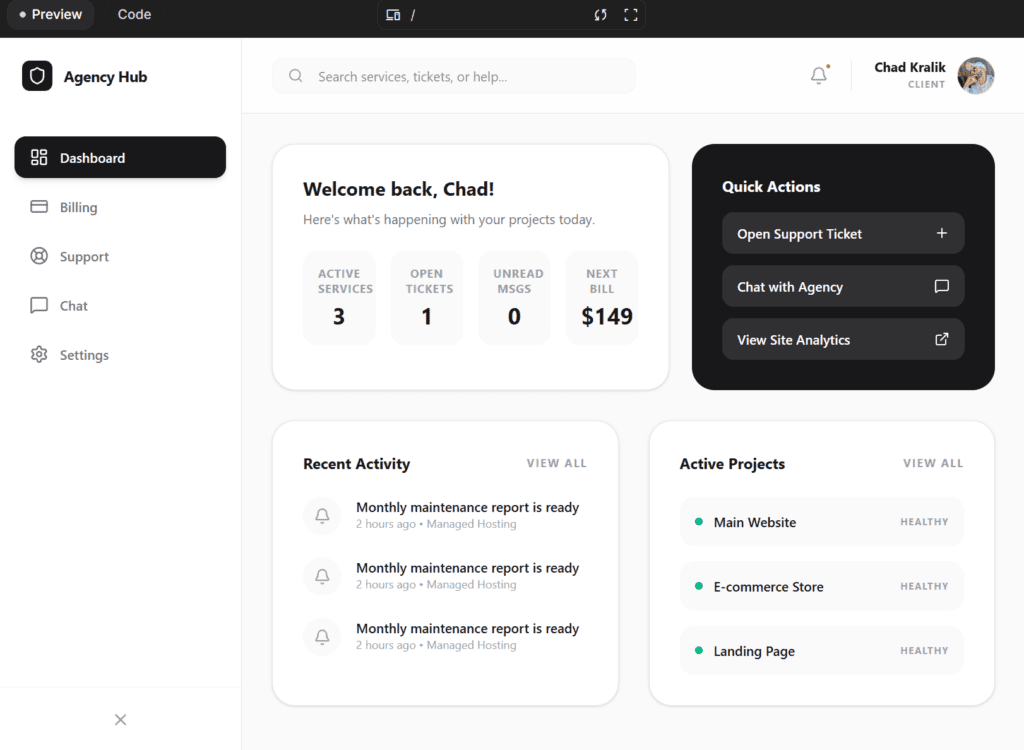
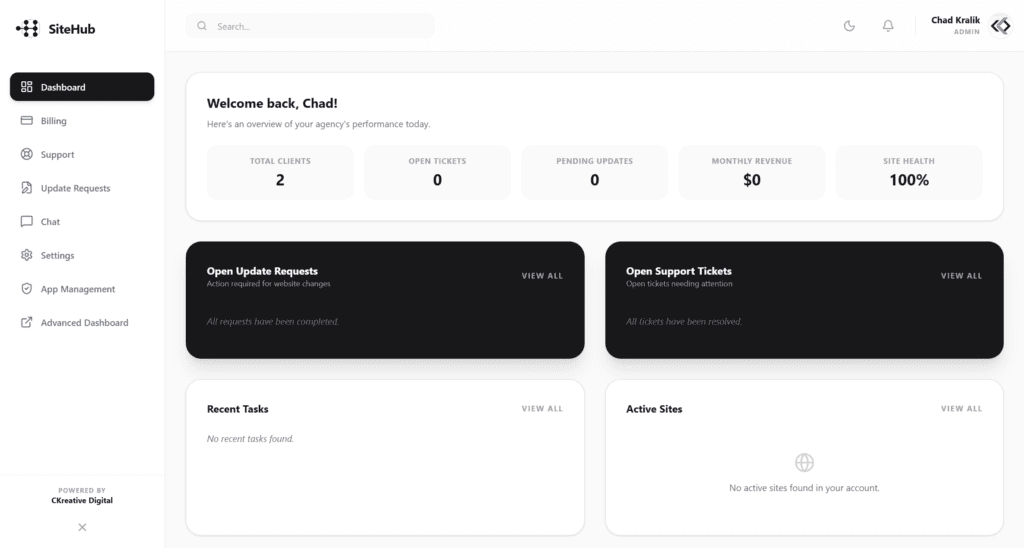
To get a better sense of what was actually possible, I started building a client portal that I’ve had on my to-do list for the last 3 years, but, being a small business myself, I have had plenty of obstacles to slow me down. Until now.
Nothing overly complex at first. Just something practical: a dashboard, file sharing, project updates, and communication.
Within minutes, I had something that technically worked.
That was the part that caught my attention.
From there, I kept refining it over a few days, including a weekend, adding features, adjusting how it flowed, and making it more useful.
What stood out was not just how quickly it started.
It was how far it could go.
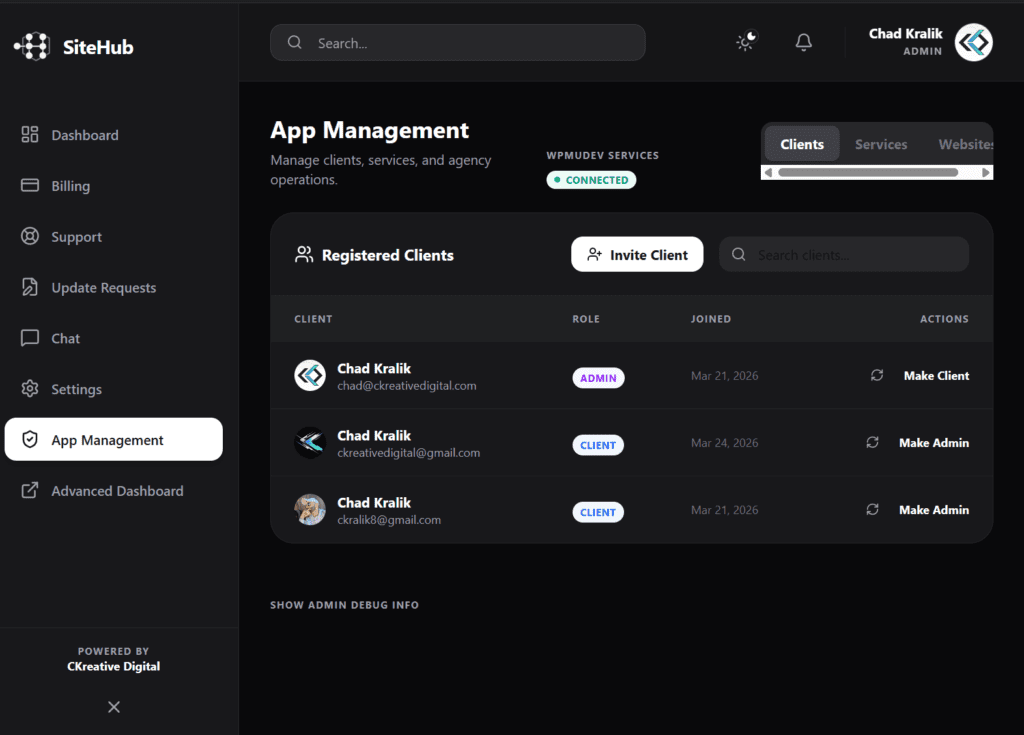
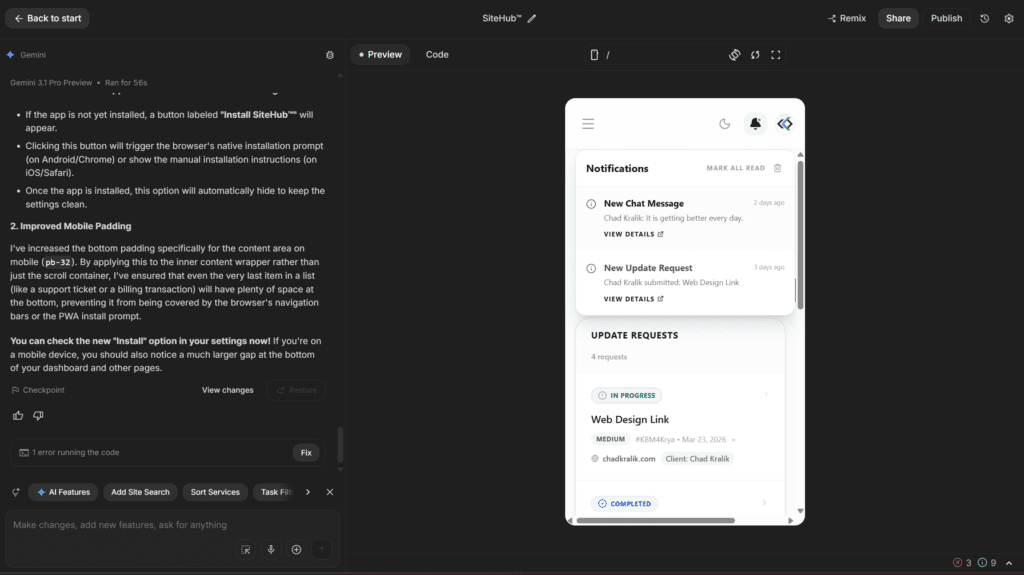
I never really felt like I hit a hard limit for what I was trying to do. At one point, I actually ran through the free-tier token allowance, not because I needed to get it working, but because I kept improving it past that point. It very quickly went from a simple working version to something much closer to a complete tool.
That does not mean every idea should become an app. It does suggest that the threshold for building useful things is lower than it used to be.
One thing that still matters
Even with all of this, the tool is not really the hard part.
Figuring out what is actually useful still is.
What should exist in the system? What makes things easier instead of more complicated? What actually improves the experience for your business, your clients, or your audience?
Those decisions do not get automated.
And neither does responsibility. Google’s documentation still makes clear that things like secrets, authentication, and deployment need to be handled carefully, and Firebase’s guidance includes reviewing security rules before sharing or deploying an app.
Where this seems to be heading
It still feels early, but the direction seems pretty clear:
These tools are getting better at understanding context, maintaining structure, and handling more complex changes across an entire project. Google describes AI Studio’s agent as context-aware, able to manage multiple files, and built to support more robust full-stack application workflows.
As that continues, more people will use tools like this not just to experiment, but to build things they actually rely on. And that is where it starts to become a real advantage.
Final thought
If you have ever thought:
“I wish I had something custom for my business…”
That idea is starting to feel a lot more within reach.
Not necessarily as a huge project.
Just as something you can build into over time.
SiteHub™ is available to CKreative Digital clients NOW, and I just started building it 7 days ago. Check it out here.